

Supreme Court orders restoration of AAP Gujarat’s Facebook, Instagram accounts
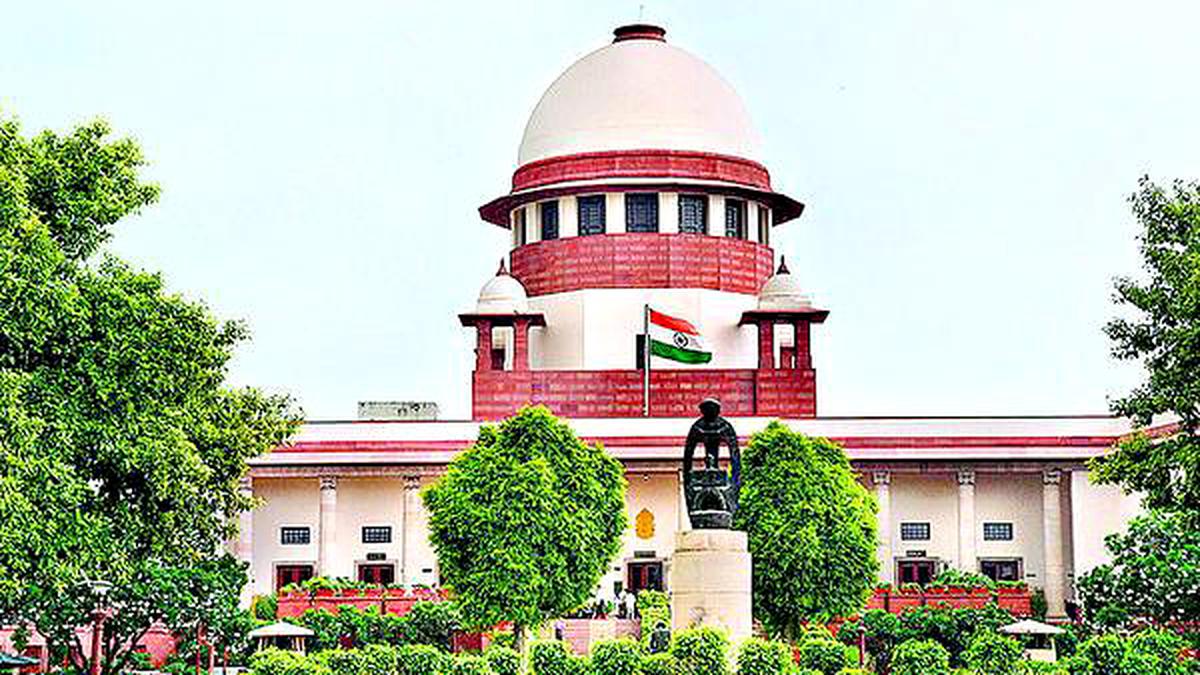
A view of the Supreme Court of India. File
| Photo Credit: The Hindu
The Supreme Court on Monday (August 17, 2026) directed the restoration of the Instagram and Facebook accounts of the Aam Aadmi Party’s (AAP’s) Gujarat unit.
A Bench of Justices P.S. Narasimha and Alok Aradhe passed the order on an interim application filed by the party.
The top court, which allowed the application subject to the removal of objectionable posts, if any, posted the main case for hearing after two weeks.

The AAP challenged what it described as an “illegal, arbitrary and unconstitutional” order to geo-block and suspend the Meta handles of the party’s Gujarat unit without giving any reason, hearing or prior notice.
In May, the court had issued notices to the Ministry of Electronics and Information Technology and the State of Gujarat on the petition filed by the AAP, which alleged that the move was intended to “silence an Opposition party and is opposed to multi-party democracy”.
AAP, represented by Senior Advocate Shadan Farasat, said its Gujarat unit’s Meta accounts, @aapgujarat [on Instagram and Facebook], had functioned as official handles for political commentary, dissemination of party policies and welfare-related information.
“They were used as legitimate platforms for political speech and democratic engagement, which fall squarely within the protection of Article 19 of the Constitution. Any action that has the effect of silencing or disproportionately restricting the voices of Opposition parties strikes at the heart of constitutional democracy and is liable to be scrutinised as a violation of the basic structure doctrine,” the AAP said.
Mr. Farasat said a direction to block an entire account, page, or group would amount to a prior restraint on free speech. He said the burden was on the Union government and the State to justify such a prior restraint.
The AAP said it was not informed of any specific content alleged to be objectionable, the statutory provision relied upon for blocking the accounts, or any factual factors.
The blocking of the accounts without any specific content-based identification was disproportionate, over-broad and manifestly beyond the scope of Article 19(2) and the powers under Section 69A of the Information Technology Act, the AAP petition had submitted.
Published – August 17, 2026 10:03 pm IST
Source: www.thehindu.com