

Indian businesses eye investment opportunities after signing of free trade agreement
Indian business organisations have hailed the ratification of New Zealand’s free trade agreement with India, saying it should pave the way for more Indian investment in the country’s infrastructure, education and healthcare sectors.
The two countries formally ratified the trade deal on Monday, with Trade Minister Todd McClay calling it the “start of an exciting new chapter in our growing relationship”.
“The benefits of the FTA (free trade agreement) are substantial,” said McClay as he exchanged formal documents with Indian High Commissioner to New Zealand Muanpuii Saiawi.
“Fifty-seven percent of New Zealand exports to India will be tariff-free on day one, including sheep meat, wool and coal exports, as well as over 95 percent of forestry and wood exports.”
The trade agreement will enter into force on 20 October, which the minister noted meant exporters would benefit from a second round of tariff cuts on 1 January 2027.
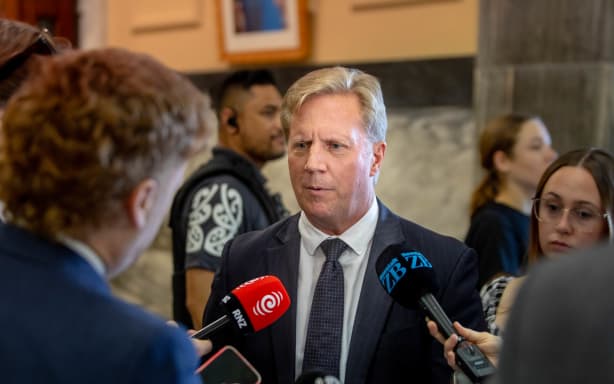
Trade Minister Todd McClay
RNZ / Mark Papalii
Bujje Babu Nelluri, president of the newly formed Andhra Pradesh Kiwis Association New Zealand, said Indian businesses were showing a greater interest in investing in New Zealand.
“We are currently facilitating two major investments worth around $100 million, with the potential to create approximately 1000 direct and indirect jobs in the country,” Nelluri said.
“Major hospital and healthcare groups from our region are interested in investing in New Zealand. We are facilitating discussions with investors and New Zealand stakeholders, with the potential to create jobs and attract more doctors, nurses and paramedical professionals.
“Indian businesses are interested in investing in education and infrastructure as well.”

Kush Bhargava, chief executive of the Aotearoa Bharat Economic Foundation
Supplied
Kush Bhargava, chief executive of Wellington-based Aotearoa Bharat Economic Foundation, said his organisation had been showcasing major New Zealand investment opportunities to Indian companies for some time.
“To streamline [such] interest better, we are launching an investment platform very soon, which could attract significant investment from India, boost the country’s infrastructure industry and create jobs,” Bhargava said.
“[We see] huge opportunities in finished goods, construction materials, green manufacturing and healthcare,” he said.
“We have already signed agreements with major Indian construction and green manufacturing companies to facilitate exports to New Zealand, potentially reducing building costs here.”

Gurdeep Talwar, co-founder of Ethnic Arts and Trade Foundation New Zealand
Supplied / Gurdeep Talwar
Gurdeep Talwar, co-founder of Ethnic Arts and Trade Foundation New Zealand, said investment opportunities existed in such areas as leather goods, saddlery, carpets, textiles, engineering products, automotive components and tyres.
“For example, India’s saddle and leather manufacturing industry could potentially serve New Zealand’s strong equestrian market, while Indian carpet manufacturers could offer more choice to New Zealand consumers and businesses,” Talwar said.
Sunny Kaushal, chief executive of the recently established India New Zealand Chamber of Commerce and Industry, called the ratification “a significant milestone” for businesses in both countries.
“[The deal] can provide greater certainty and new opportunities for Indian businesses looking to trade with, invest in or establish a presence in New Zealand,” Kaushal said.
“We are building connections between businesses, investors, industry bodies and institutions in both countries, and helping them explore market-entry opportunities, B2B (business-to-business) partnerships and investment pathways.
“Forestry and wood products, sheep meat and wool, food and beverage, advanced manufacturing, technology, education, tourism and professional services all have opportunities to explore.”
Bharat Chawla, chair of the India New Zealand Business Council, sounded a note of caution, noting that while the trade agreement would not automatically generate Indian investment in New Zealand, it should give investors greater certainty in a much deeper commercial relationship.
“Investment normally follows trade and relationships,” Chawla said.
“The FTA creates the framework. Businesses still have to turn that framework into investment.”
Chawla highlighted opportunities in higher education and research, fintech, engineering and professional services, which he said had “considerable room to grow”.
“The opportunity is much broader than apples and kiwifruit,” he said.
“Tourism should also benefit as travel between our two countries becomes simpler.
“For a country like New Zealand, many of our future India opportunities will be based on knowledge, technology and specialist capability rather than simply shipping physical products.
“This isn’t a one-sector deal. It’s a platform for a much broader economic relationship.”
Source: www.rnz.co.nz